ClipKaro
Turns long Hindi and Hinglish podcasts into vertical Shorts with word-by-word captions.
clipkaro.live2026
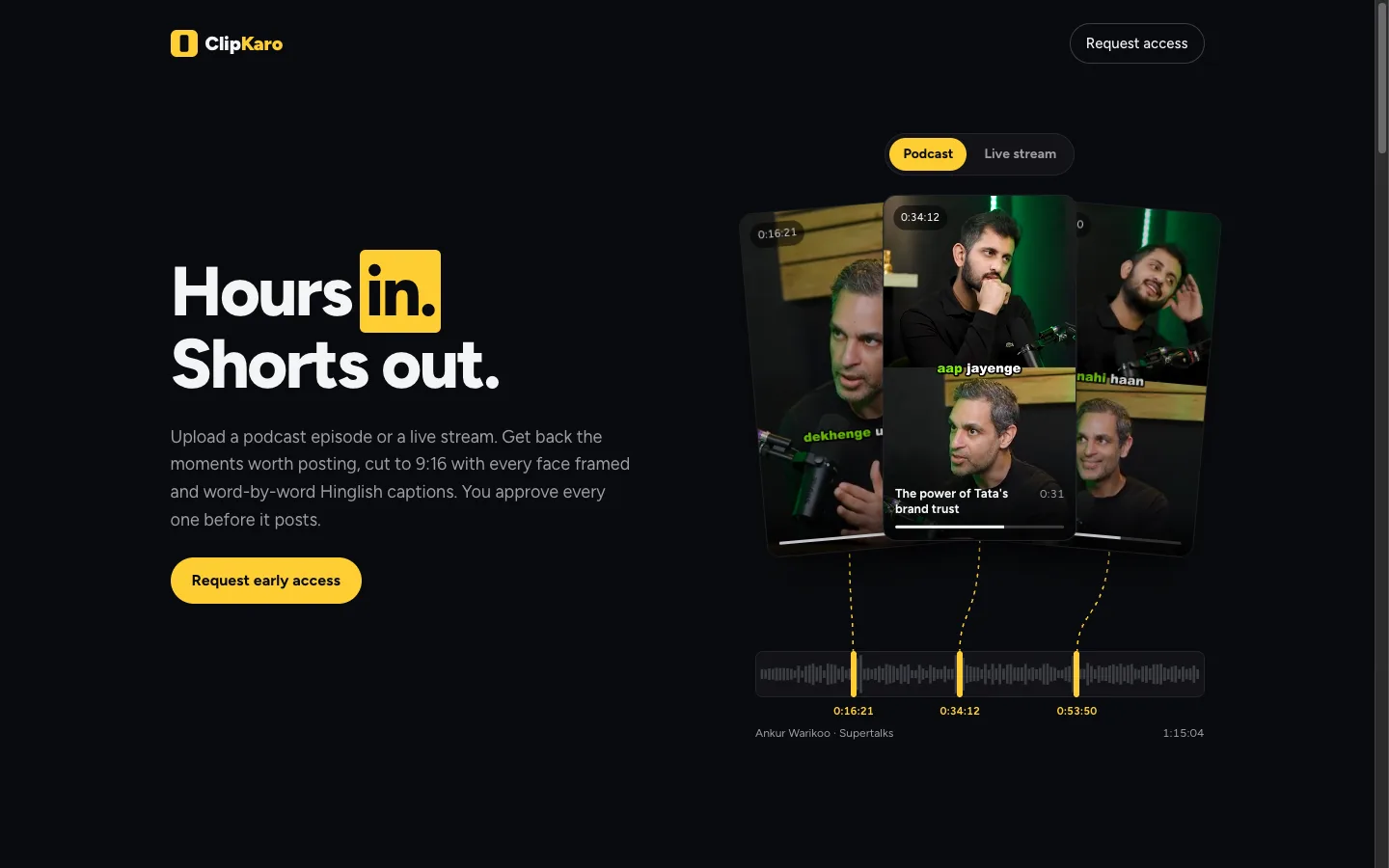
What it does
You give ClipKaro a long podcast or stream. It finds the 10 to 20 moments worth clipping and labels each one. It frames every face for 9:16: one person is cropped on their face, two people are stacked one above the other. Then it renders the clip with word-by-word captions in Roman or Devanagari and publishes it to a review dashboard. Nothing is posted anywhere until the creator approves it.
Indian creators pay editors for every Short, and the popular clipping tools are built for English. They break on Hinglish, where a sentence switches language halfway through. ClipKaro is built for that case first.
How a video becomes clips
- Analysis. Cheap signals run over the whole video: bursts in the audio and YouTube’s “most replayed” graph. The top 5% or so become candidate windows. Only those are transcribed and scored by a language model, which returns an exact start and end, a title, a hook and a label.
- Edit. The video is classified as a single camera or a podcast grid. A template is picked per moment. Camera cuts and faces are found in each shot, and an edit plan is written per clip.
- Render. ffmpeg and libass turn each plan into a clip, with layouts switched by frame number, zooms, captions and an outro. Each clip also gets an edit pack with the raw footage and subtitles for anyone who wants to finish it by hand.
- Publish. Clips appear on the dashboard one by one while the job is still running.
The layers only talk to each other through versioned JSON contracts, so any one of them can be rewritten without touching the others.
The hard part: cost
A five-hour stream cannot be transcribed and scored in full at a price a creator would pay. The fix was to stop sending everything to the expensive models. Signals that cost almost nothing run over the whole video on CPU, and only the windows they pick go on to transcription and scoring. That cut the cost per hour by more than half.
Today the whole pipeline runs in AWS on spot instances. A 60-minute video takes about 6 to 9 minutes and costs about Rs 13 to 16 per source hour.
The other hard part: rendering without a browser
The look for the clips was designed in a tool that renders HTML in headless Chrome. The workers are ARM spot instances, and that Chrome build does not exist for them. So an edit plan now compiles straight to one ffmpeg filter graph and one subtitle file. Renders are frame exact, repeatable, and cost only CPU. The price is that matching a look designed in a browser takes a side-by-side check, because the two draw text slightly differently.